On January 14, 2026, Associate Professor JieMin Jia from Westlake University visited the Center for Biomedical Optics and Molecular Imaging at the invitation of Professor Chengbo Liu from the Shenzhen Institutes of Advanced Technology (SIAT), Chinese Academy of Sciences. During the visit, she delivered an academic lecture titled "Neurovascular coupling in health and stroke".
Neurovascular coupling (NVC) is important for brain function and its dysfunction underlies many neuropathologies. Although cell-type specificity has been implicated in NVC, how active neural information is conveyed to the targeted arterioles in the brain remains poorly understood.
In the report, Professor Jia mainly discussed the following topics: (1) Using two-photon focal optogenetics in the mouse cerebral cortex to demonstrate that single glutamatergic axons dilate their innervating arterioles via synaptic-like transmission between neural–arteriolar smooth muscle cell junctions (NsMJs); (2) Elucidating the mechanism where the presynaptic parental–daughter bouton makes dual innervations on postsynaptic dendrites and on arteriolar smooth muscle cells (aSMCs), as well as the expression of glutamate NMDA receptor subunit 1 (Grin1) in aSMCs; (3) Discussing experimental results showing that disruption of NsMJ transmission by aSMC-specific knockout of GluN1 diminished optogenetic and whisker stimulation-caused functional hyperemia; (4) Introducing new findings in stroke research, specifically that the absence of GluN1 subunit in aSMCs reduced brain atrophy following cerebral ischemia by preventing Ca2+ overload in aSMCs during arteriolar constriction caused by the ischemia-induced spreading depolarization. These findings reveal that NsMJ transmission drives NVC and open up a new avenue for studying stroke.
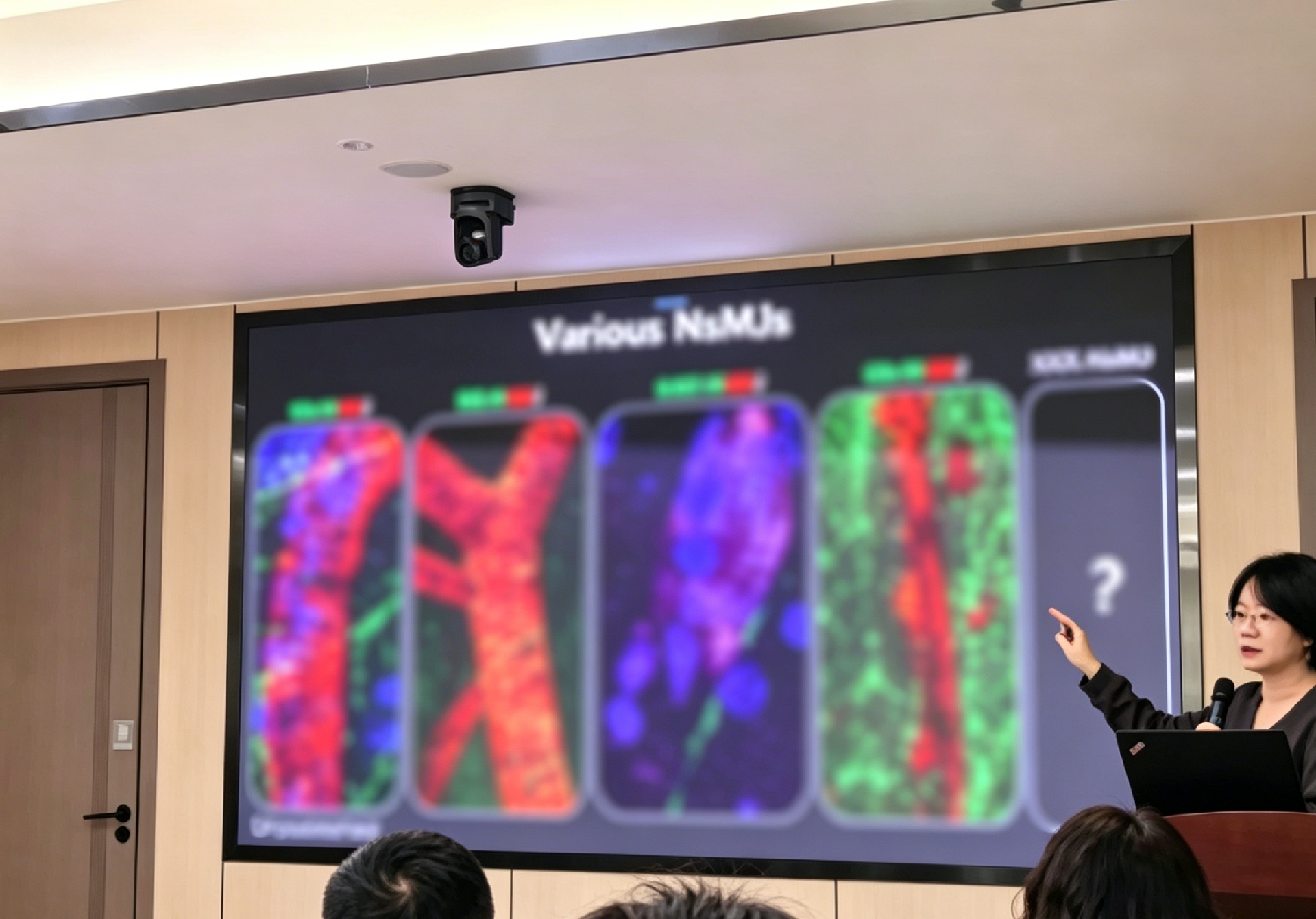
Associate Professor Jie-Min Jia delivering the academic lecture
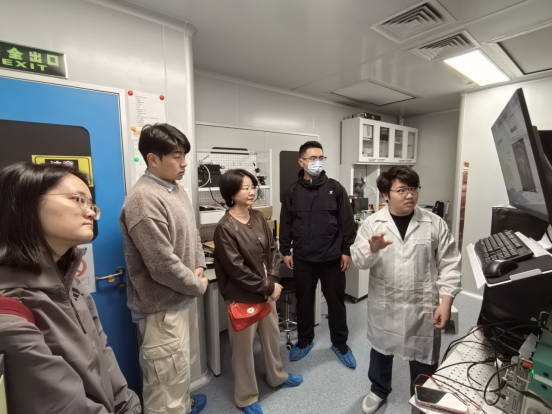
Professor Jia and Professor Chengbo Liu engaging in discussion in the laboratory
Biography:
Dr. JieMin Jia received her PhD degree from the Institute of Neuroscience (ION) in the Chinese Academy of Sciences in 2009, and then moved to the USA for postdoctoral training at the National Institute of Mental Health (NIMH in the NIH (2009-2014) and the Children’s Research Institute (CRI) in UTSW (2014-2017). In 2017, she joined Westlake University as an assistant professor of the laboratory of Neurovascular Biology. Now, she was promoted to an associate professor. Her lab mainly focuses on cerebral blood flow regulation mechanisms and their applications in brain disease conditions.

