The acidic microenvironment is a hallmark of tumor initiation and progression. It plays a crucial role in promoting tumor growth, invasion, and metastasis. Therefore, the detection and targeted regulation of tumor acidity are of great importance for cancer diagnosis and therapy. Imaging technologies have significantly advanced our understanding of tumor initiation, development, and dynamic progression. However, existing techniques still face challenges in achieving sufficient sensitivity and specificity. Developing imaging and quantitative analysis methods capable of highly sensitive and specific visualization of tumor acidity in vivo is therefore of great value for studying the acidic tumor microenvironment.
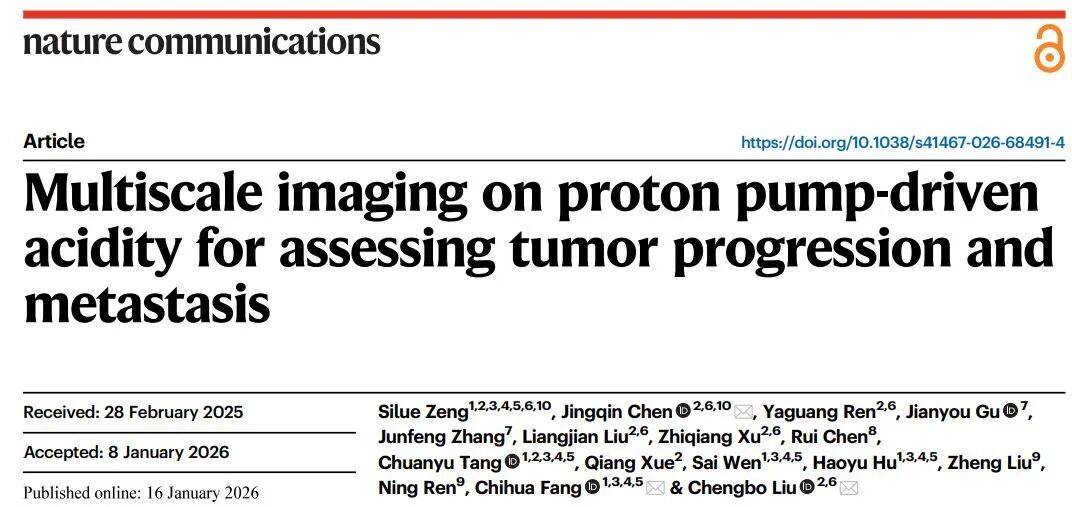
Recently, a research team led by Liu Chengbo and Chen Jingqin from the National Key Laboratory of Medical Imaging Science and Technology System at the Shenzhen Institutes of Advanced Technology, Chinese Academy of Sciences, in collaboration with the group of Fang Chihua from Zhujiang Hospital, Southern Medical University, achieved real-time dynamic assessment of tumor acidity by integrating multiscale photoacoustic molecular imaging with a pH-responsive ratiometric molecular probe. This approach enabled dynamic in vivo imaging across multiple stages of tumor development—from early tumor formation to tumor progression and late-stage metastasis—allowing continuous quantitative monitoring of the spatiotemporal acidification process within the tumor microenvironment. Furthermore, the method was applied to boundary imaging of human ex vivo tumor specimens, demonstrating its potential for clinical translation. The study was published in Nature Communications under the title “Multiscale imaging on proton pump-driven acidity for assessing tumor progression and metastasis.”
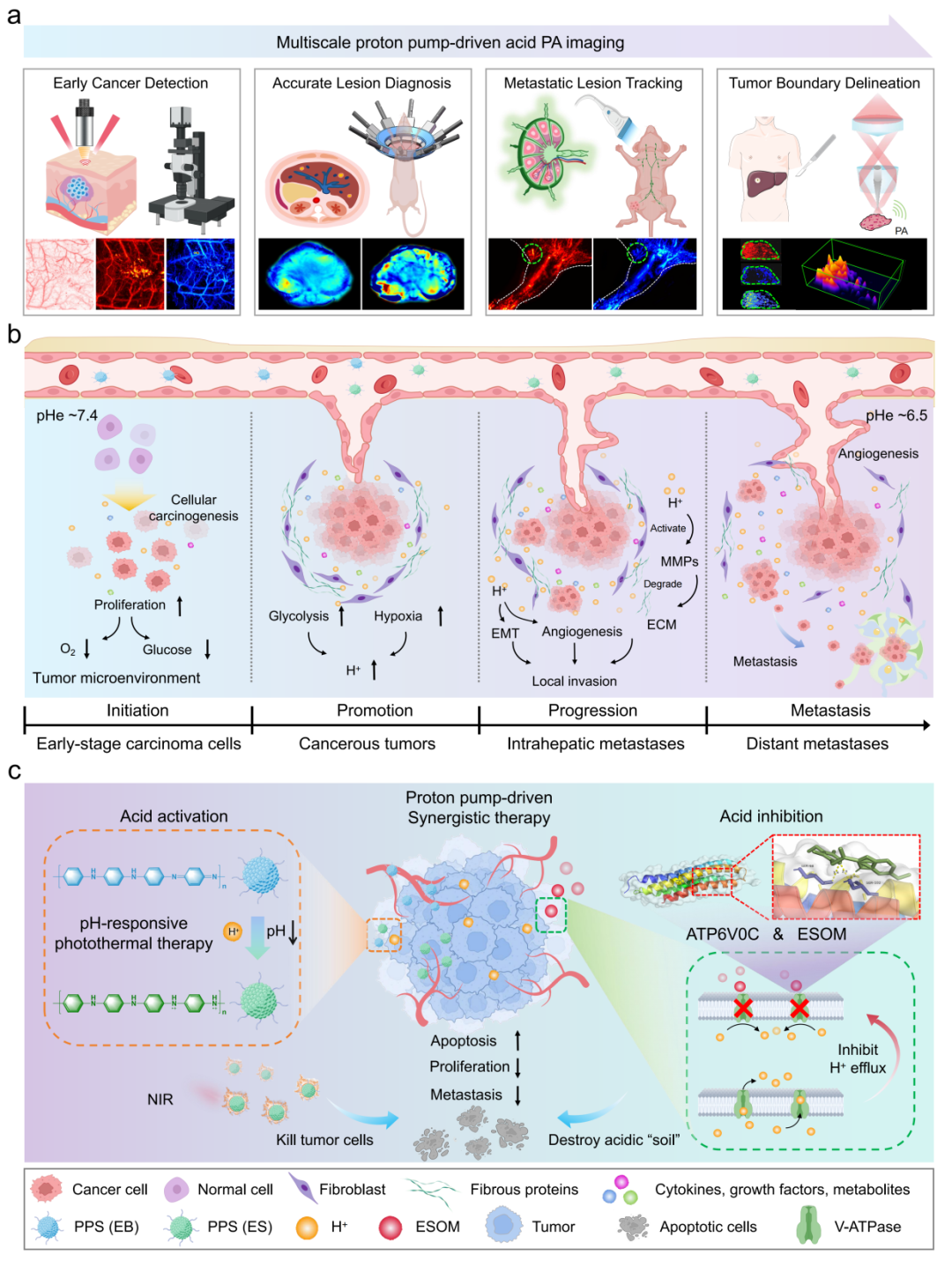
Using a self-developed multiscale photoacoustic molecular imaging system, the team achieved visualization of tumor progression across multiple stages, ranging from early microscopic lesions to the proliferation of in situ solid tumors and lymphatic metastasis to distant sites. This approach revealed the spatial expansion and dynamic intensity changes of the acidic microenvironment accompanying tumor evolution. In addition, precise delineation of tumor boundaries was achieved in ex vivo human hepatocellular carcinoma specimens.
The study further found that the pH-responsive ratiometric molecular probe exhibits an enhanced photothermal effect under acidic conditions. When combined with proton pump inhibitors, the probe demonstrated a synergistic effect in suppressing tumor growth, highlighting promising therapeutic potential for cancer treatment. Overall, this work demonstrates the critical role of the acidic microenvironment in malignant tumor progression. It provides a new imaging paradigm for early tumor diagnosis and progression assessment based on tumor acidity, and offers a novel tool for the development of acidity-targeted cancer therapy strategies.
The corresponding authors of the paper are Liu Chengbo (Researcher) and Chen Jingqin (Associate Researcher) from the Shenzhen Institutes of Advanced Technology, Chinese Academy of Sciences, and Fang Chihua (Professor) from Southern Medical University. Zeng Silue, a postdoctoral researcher at Southern Medical University, and Chen Jingqin from Shenzhen Institutes of Advanced Technology are the co–first authors of the paper.
This work was supported by the National Key Research and Development Program of China, the National Natural Science Foundation of China, and the National Key Laboratory of Medical Imaging Science and Technology System, among other funding programs and research platforms.

